Within Thin Pages
The Missing Warnings in Thin Reviews
Useful affiliate reviews earn trust by saying who should avoid a product, not only who should buy it.
On this page
- Why drawbacks make recommendations stronger
- Common hidden costs and fit problems
- How to write buyer specific warnings
Page outline Jump by section
Introduction
Thin affiliate reviews often fail because they present products as if every buyer will have the same experience. They list features, repeat marketing claims and end with a purchase link, but rarely explain the compromises that come with choosing one product over another. That absence of judgement makes the page less useful to readers and less distinctive to search engines looking for original, people-first content. Google’s guidance consistently encourages content that adds genuine analysis rather than rewriting existing sources, while its product review recommendations favour reviews that explain benefits, drawbacks and meaningful comparisons.[Google for Developers]developers.google.comGoogle for DevelopersCreating Helpful, Reliable, People-First ContentGoogle's ranking systems are designed to present helpful, reliable i…
 The strongest affiliate reviews do not simply answer, “Why should someone buy this?” They also answer, “Who should not buy this?” That single shift transforms a sales page into buying advice.
Why drawbacks make recommendations stronger
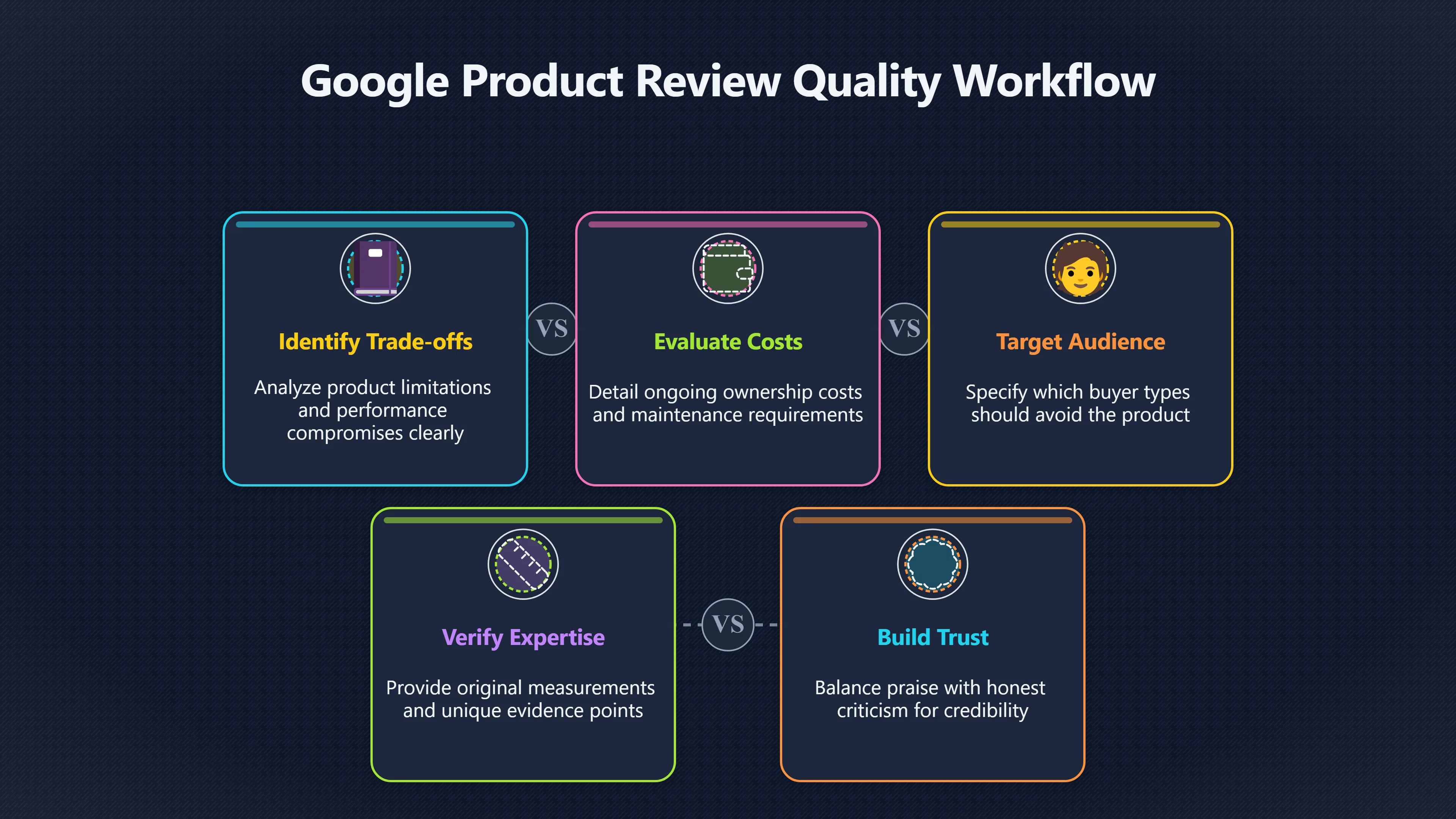
Every product involves trade-offs. A laptop with exceptional battery life may sacrifice processing power. A premium coffee machine may produce excellent espresso but require expensive maintenance. A budget air purifier may clean small rooms well but struggle in larger spaces.
When a review ignores those compromises, readers instinctively recognise the imbalance. Marketing material naturally emphasises strengths. Independent reviewers earn trust by identifying the limitations that manufacturers prefer not to highlight.
This also creates original editorial value. Anyone can rewrite a specification sheet. Explaining that a camera’s excellent image quality comes at the cost of slower autofocus for sports photography requires evaluation rather than summarisation.
Google’s guidance for helpful content asks creators whether they provide original information, insightful analysis and substantial added value instead of simply rewriting other sources. Honest discussion of trade-offs directly supports those goals.[Google for Developers]developers.google.comGoogle for DevelopersCreating Helpful, Reliable, People-First ContentGoogle's ranking systems are designed to present helpful, reliable i…
A balanced review therefore becomes more persuasive, not less persuasive. Readers are more likely to believe praise after seeing genuine criticism than after reading an uninterrupted list of positives.
Common hidden costs and fit problems
Thin affiliate pages often hide the factors that matter most after purchase. These omissions may not be deliberate, but they leave buyers unable to judge whether the recommendation actually fits their situation.
Common examples include:
- Ongoing ownership costs. Subscription fees, replacement filters, consumables, accessories and maintenance may exceed the initial purchase price over time.
- Learning curve. Products marketed as “easy to use” may actually require significant setup or technical knowledge before delivering their advertised benefits.
- Compatibility limits. Devices may work only within particular ecosystems or require additional hardware to unlock advertised features.
- Performance compromises. One strength often creates another weakness, such as lighter weight reducing durability or compact size limiting capacity.
- Environmental constraints. Products that perform well in ideal conditions may struggle in larger homes, noisy environments or demanding workloads.
- User expectations. A beginner and a professional often need different things, yet thin reviews frequently recommend the same product to everyone.
These details frequently determine buyer satisfaction far more than headline specifications.
For affiliate publishers, they also create information that cannot easily be copied from retailer listings. A manufacturer can describe battery capacity. It is much harder for them to explain that frequent travellers may appreciate the battery life while office workers would probably benefit more from a cheaper model with better performance.
Why buyer-specific warnings increase trust
The most useful warnings are targeted rather than generic.
Instead of writing:
“This product isn’t perfect.”
A stronger review explains:
“Avoid this if you regularly edit 4K video. The processor performs well for office work, but sustained rendering workloads expose its thermal limits.”
That advice immediately helps one group of readers while reassuring another.
Buyer-specific warnings demonstrate that the reviewer has considered different purchasing scenarios instead of assuming every visitor shares identical priorities.
Useful warning categories include:
- Who should choose another product instead.
- Situations where the product performs poorly.
- Budget levels where spending more delivers meaningful benefits.
- Budget levels where spending less sacrifices very little.
- Features that sound important but rarely matter in normal use.
- Features that genuinely become important only for particular users.
This approach reduces unnecessary purchases while increasing reader confidence in future recommendations.

The mechanism behind hidden trade-offs
Many thin reviews avoid negatives because affiliate publishers worry criticism will reduce conversions.
In practice, the opposite often happens over the long term.
Readers expect expensive purchases to involve compromise. If every reviewed product receives five-star praise with only token criticisms such as “slightly expensive” or “available in limited colours”, the reviews begin to resemble advertising copy.
Search quality guidance has increasingly favoured reviews that demonstrate expertise, evidence and thoughtful evaluation rather than surface-level summaries. Google’s product review guidance has consistently encouraged detailed analysis, comparisons, measurements where appropriate and discussion of benefits alongside limitations.[gsqi.com]gsqi.comgoogle product reviews algorithm updateGoogle's Product Reviews Update – Analysis and findings22 Apr 2021 — Google's Product Reviews Update – Analysis and findings from a major…
The hidden trade-off is therefore commercial rather than editorial:
- Avoiding criticism may slightly increase short-term clicks.
- Honest criticism increases long-term credibility, repeat visitors and distinctive content.
Affiliate sites depend heavily on trust because readers often encounter them before they encounter the merchant. If that trust disappears, every recommendation becomes less valuable.
How to write buyer-specific warnings
The easiest way to improve an affiliate review is to treat every recommendation as a matching exercise rather than a sales pitch.
For each product, answer questions such as:
- Which type of buyer benefits most?
- Which buyer would probably regret purchasing it?
- What compromise does this product make to achieve its biggest advantage?
- What additional costs appear after purchase?
- Under what circumstances would a competing product become the better choice?
- Which common complaints are reasonable, and which are simply unrealistic expectations?
Notice that none of these questions require dramatic criticism. They simply require judgement.
For example, a standing desk might receive an honest warning that it is unsuitable for users who frequently need large permanent desktop setups because the lifting mechanism performs best with moderate loads. A budget robot vacuum may be recommended for hard floors while being discouraged for homes with thick carpets and multiple pets.
These warnings make recommendations more precise rather than more negative.
Thin reviews confuse positivity with usefulness
A review that never says “no” rarely helps someone decide.
Readers visit affiliate reviews because they need assistance navigating competing products with different strengths and weaknesses. If every recommendation sounds equally enthusiastic, the review provides little more than a rewritten catalogue.
The pages that stand out are those willing to explain uncomfortable but useful truths: the premium option that is not worth the extra money for most buyers, the cheaper model that covers 90% of real-world needs, or the popular product that simply does not suit a particular audience.
Those trade-offs are difficult to automate, difficult to copy from merchant pages and genuinely valuable to readers. They are also the kind of original judgement that separates useful affiliate content from thin affiliate content.[Google for Developers+2gsqi.com]developers.google.comGoogle for DevelopersCreating Helpful, Reliable, People-First ContentGoogle's ranking systems are designed to present helpful, reliable i…
Amazon book picks
Further Reading
Books and field guides related to The Missing Warnings in Thin Reviews. Use these as the next step if you want deeper reading beyond the article.
Everybody Writes
Promotes honest, useful writing that addresses reader questions and trade-offs.
Building a StoryBrand 2.0
Encourages addressing different buyer situations, including who should not buy.
The Art of SEO
Reinforces the value of original analysis over rewritten product descriptions.
Made to Stick
Helps writers communicate meaningful trade-offs and memorable buying advice.
eBay marketplace picks
Marketplace Samples
Example marketplace items related to this page. Use the search link to explore similar finds on eBay.


Endnotes
1.
Source: developers.google.com
Link:https://developers.google.com/search/docs/fundamentals/creating-helpful-content
Source snippet
Google for DevelopersCreating Helpful, Reliable, People-First ContentGoogle's ranking systems are designed to present helpful, reliable i...
2.
Source: gsqi.com
Title: google product reviews algorithm update
Link:https://www.gsqi.com/marketing-blog/google-product-reviews-algorithm-update/
Source snippet
Google's Product Reviews Update – Analysis and findings22 Apr 2021 — Google's Product Reviews Update – Analysis and findings from a major...
3.
Source: support.google.com
Link:https://support.google.com/webmasters/thread/180636419/does-the-ratio-of-commercial-content-on-the-site-vs-informative-matter-for-product-reviews-sites?hl=en
Source snippet
Does the...
Additional References
4.
Source: impact.com
Link:https://impact.com/influencer/ai-overview-content-strategy/
Source snippet
A 5-Step Human-First AI Content Checklist for Affiliate...AI won't kill affiliate marketing, but it will kill lazy strategies...
5.
Source: susodigital.com
Title: SUSOHow to Write Product Reviews: The Google Way
Link:https://susodigital.com/thoughts/how-to-write-product-reviews-the-google-way/
Source snippet
How to Write Product Reviews: The Google Way - SUSO Digital28 Mar 2023 — Learn how to fine-tune your content and make sure that your prod...
6.
Source: facebook.com
Title: Ever needed to write a product review?
Link:https://www.facebook.com/chrismwalkerentrepreneur/posts/ever-needed-to-write-a-product-review-the-superstar-seo-content-team-created-a-g/3019386048316747/
Source snippet
The Superstar SEO...7️⃣ Include pros and cons: Be transparent by highlighting both the positive and negative aspects of the product. 8️⃣...
7.
Source: youtube.com
Title: How To Write Product Reviews (For Affiliate Websites) That Convert Like Crazy
Link:https://www.youtube.com/watch?v=PKSQrwDXFgQ
Source snippet
Kevin Indig [Shopify's Director of SEO] On How To Adapt and Win With SEO Changes...
8.
Source: youtube.com
Title: Kevin Indig [Shopify’s Director of SEO] On How To Adapt and Win With SEO Changes
Link:https://www.youtube.com/watch?v=1yVxTcbO6Bs
Source snippet
Influencer “Reviews” Are Ads — Brands Control the Script...
9.
Source: youtube.com
Title: Google announced a product review algorithm update! What I’m doing TODAY!
Link:https://www.youtube.com/watch?v=XYXACNW4BMw
Source snippet
Google's Review [Updates]({{ 'updates/' | relative_url }}): 5 Changes Every Business Needs to Know...
10.
Source: youtube.com
Title: Influencer “Reviews” Are Ads — Brands Control the Script
Link:https://www.youtube.com/watch?v=TCL1oaexVHk
Source snippet
Google announced a product review algorithm update! What I'm doing TODAY...
11.
Source: mariehaynes.com
Title: google ai systems
Link:https://www.mariehaynes.com/google-ai-systems/
Source snippet
This system uses machine learning to predict whether content is likely to be the most...Read more...
12.
Source: stellarcontent.com
Title: Google’s Product Review Algo Update
Link:https://www.stellarcontent.com/blog/ecommerce/googles-product-review-algo-update-what-does-it-mean-for-content-creation/
Source snippet
If you're...Read more...
13.
Source: youtube.com
Title: Google’s Review Updates: 5 Changes Every Business Needs to Know
Link:https://www.youtube.com/watch?v=_U–6ISiHwQ
Topic Tree