Within Long Tail
What Do You Give Up to Get the Fit?
Budget, space, noise, weight, and maintenance constraints can turn a generic product list into a useful buying decision.
On this page
- The constraints that usually change rankings
- How to explain trade offs without overselling
- Good and bad examples of constraint led pages
Page outline Jump by section
Introduction
Constraint-led buying queries convert because the shopper has already accepted that no product is perfect. Instead of asking for the “best” option, they are asking which compromise is least painful for their situation. Searches such as “best washing machine for a small flat”, “quiet treadmill for upstairs flat”, or “lightweight laptop under £700” are really requests for trade-off advice rather than product lists.
 For affiliate websites, this creates an opportunity to publish pages that genuinely help readers make decisions. Instead of ranking products by a single score, the page explains what changes when budget, space, weight, maintenance, noise, portability or physical limitations become the deciding factor. This approach aligns well with Google’s emphasis on original, people-first content that demonstrates useful judgement rather than recycled specifications.[Google for Developers]developers.google.comGoogle for DevelopersCreating Helpful, Reliable, People-First ContentGoogle's ranking systems are designed to present helpful, reliable i…
What constraints usually change product rankings?
A product that wins a general “best” roundup often loses once a real-world limitation is introduced. Constraint-led pages should therefore begin with the limitation rather than the product category.
Some of the most commercially valuable constraints include:
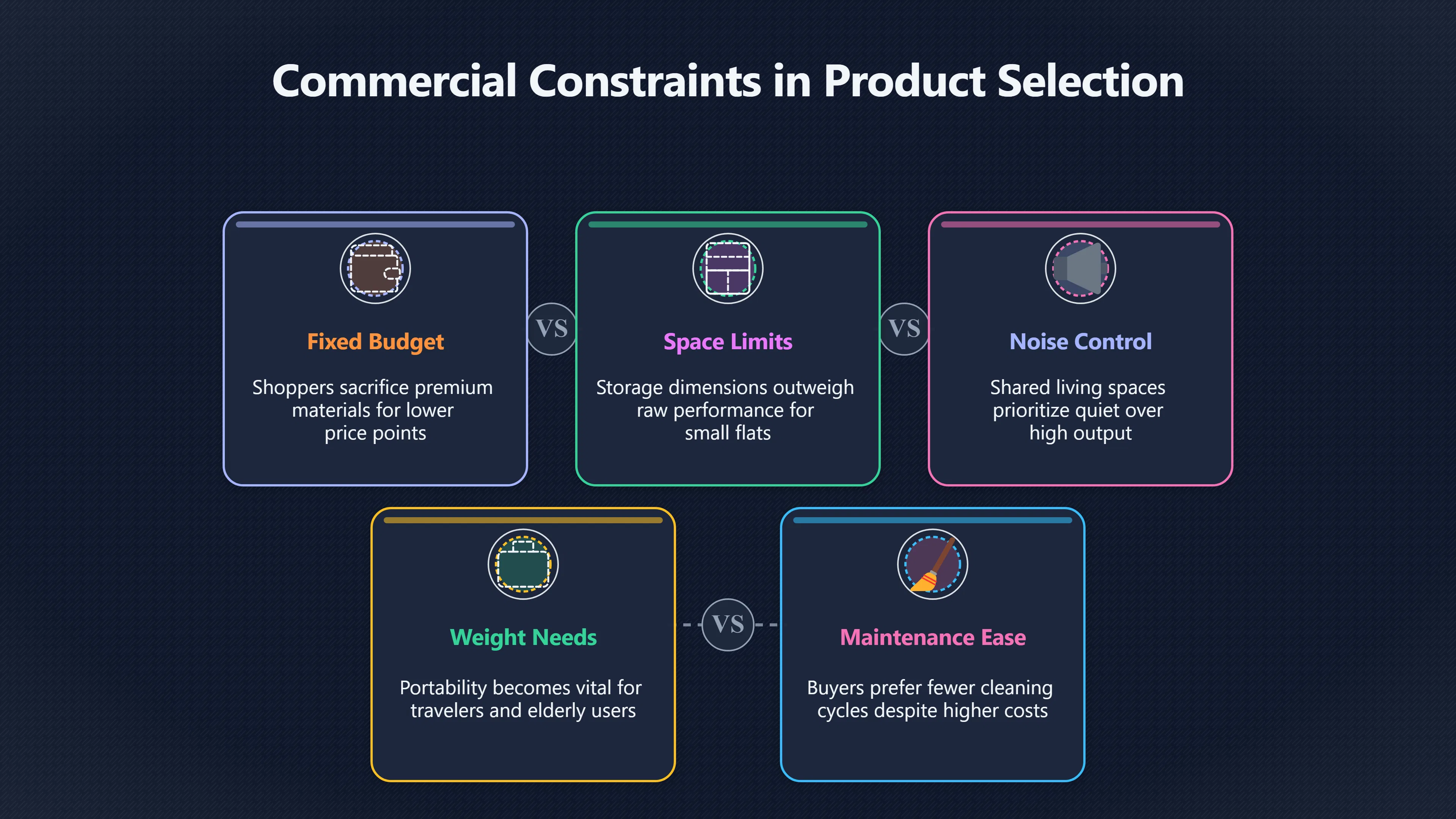
- Budget: A shopper may willingly sacrifice premium materials, extra features or maximum performance to stay within a fixed price.
- Available space: Storage dimensions, folding mechanisms and physical footprint become more important than raw performance.
- Noise: Shared homes, flats and home offices often favour quieter products even when they deliver slightly lower output.
- Weight: Older buyers, travellers or anyone with limited strength may prioritise portability over capacity or battery life.
- Maintenance: Some buyers prefer products requiring fewer consumables, cleaning cycles or replacement parts even if the purchase price is higher.
- Compatibility: Existing equipment, furniture or software can eliminate otherwise excellent products.
- Accessibility: Reduced mobility, arthritis, visual impairment or other physical limitations frequently change what “best” means.
These constraints rarely exist alone. A buyer searching for a “quiet cordless vacuum for a small flat under £250” has already combined three separate decision filters. The affiliate page succeeds by explaining how those constraints interact rather than independently scoring products.
What do you give up to get the fit?
Trade-off pages perform well because they answer the uncomfortable question that retailers often avoid: what must the buyer sacrifice?
Instead of pretending every recommendation excels at everything, make the compromises explicit.
ConstraintCommon gainCommon compromiseLower budgetBetter affordabilityFewer premium features, lower durability, weaker supportSmaller sizeEasier storageReduced capacity or powerLower weightEasier carryingShorter battery life or less robust constructionQuieter operationBetter shared-space useSlower performance or lower outputLower maintenanceLess ongoing workHigher purchase priceCompact portabilityEasier travelReduced repairability or expandability
This framework helps readers understand why recommendations differ across pages.
For example, the quietest air purifier may not clean the largest room. The lightest suitcase may be less durable. The cheapest printer may have the highest ink costs. Explaining these relationships creates genuine editorial value that cannot be replicated simply by copying manufacturer specifications.
How to explain trade-offs without overselling
The goal is not to persuade readers that every compromise is acceptable. The goal is to match compromises with buyer priorities.
Useful constraint-led pages usually follow a pattern.
Begin by explaining why the constraint changes the buying criteria.
For example:
“If you live in a small flat, storage space matters almost as much as cleaning performance because a machine that cannot be stored conveniently often ends up being used less.”
Only then should individual recommendations appear.
For every recommendation, identify:
- what it does particularly well
- what it gives up compared with the category leader
- who should accept that compromise
- who should avoid it
This approach is especially effective because different buyers willingly make different sacrifices.
Someone living in rented accommodation may accept slightly lower performance for significantly lower noise.
A traveller may happily trade processing power for half the carrying weight.
A pensioner may value simple controls over advanced automation.
These explanations demonstrate judgement rather than merely listing specifications, matching Google’s guidance that valuable content should add original analysis instead of rewriting information already available elsewhere.[Google for Developers]developers.google.comGoogle for DevelopersCreating Helpful, Reliable, People-First ContentGoogle's ranking systems are designed to present helpful, reliable i…
Why these pages often convert better than generic “best” lists
Constraint searches reveal unusually strong buying intent.
By the time someone includes words such as:
- under £500
- lightweight
- for small kitchen
- easy to maintain
- quiet
- compact
- suitable for arthritis
- low running costs
they are usually narrowing a shortlist rather than exploring a category.
The affiliate page therefore becomes the final decision aid instead of an introductory guide.
Conversions improve because the page removes uncertainty.
Rather than saying, “This is the highest-rated product,” it answers, “This is the least frustrating option if your biggest problem is limited space.”
That distinction is often what separates an informative page from one that genuinely influences a purchase.
Good examples of constraint-led pages
Strong pages usually focus on one dominant limitation.
Examples include:
- Best robot vacuums for small flats with pets
- Best lightweight cabin suitcases for frequent flyers
- Best office chairs for short people under £300
- Best coffee machines with minimal cleaning
- Best laptops under £700 for university students
- Best quiet treadmills for upstairs flats
- Best cordless drills for occasional DIY
Notice that every title implies a compromise.
The page is not searching for universal superiority.
It is searching for the best fit within a clearly defined limitation.

Poor examples that rarely add value
Many affiliate pages mention constraints only in headings while recommending almost identical products to every other buying guide.
Weak pages often:
- rank products without explaining why the constraint changes the decision
- repeat manufacturer specifications instead of interpreting them
- recommend expensive premium models on budget-focused pages
- ignore the disadvantages of each recommendation
- claim every product is suitable for every buyer
- copy broad “top ten” lists with only the title changed
Readers quickly recognise these pages because the recommendations fail to reflect the stated problem.
A page called “Best vacuum for tiny flats” that spends most of its time discussing suction power while barely mentioning storage dimensions has misunderstood the search intent entirely.
Building trust through honest compromises
Constraint-led affiliate content works because it acknowledges that buying decisions are rarely about finding perfection. They are about choosing the compromise that fits one person’s circumstances better than another’s.
Pages that openly discuss what buyers gain and lose create more confidence than pages that attempt to present every recommendation as universally superior. That honesty also makes the content more distinctive, more useful and more consistent with Google’s people-first guidance, since it contributes practical judgement instead of simply aggregating product information.[Google for Developers]developers.google.comGoogle for DevelopersCreating Helpful, Reliable, People-First ContentGoogle's ranking systems are designed to present helpful, reliable i…
Amazon book picks
Further Reading
Books and field guides related to What Do You Give Up to Get the Fit?. Use these as the next step if you want deeper reading beyond the article.
The Design of Everyday Things
Helps readers understand why product design forces compromises between usability, features, and performance.
The Paradox of Choice: Why More Is Less
Rating: 3.5/5 from 13 Google Books ratings
Explains how people evaluate trade-offs and make decisions when every option involves compromises.
Thinking, Fast and Slow
Provides foundational insight into judgment, bias, and decision-making relevant to evaluating constrained buying choices.
Buyology: Truth and Lies About Why We Buy
Rating: 4.0/5 from 5 Google Books ratings
Explores purchasing behavior and the factors that influence buying decisions beyond specifications.
eBay marketplace picks
Marketplace Samples
Live-tested eBay searches with available results related to this page.




Endnotes
1.
Source: developers.google.com
Link:https://developers.google.com/search/docs/fundamentals/creating-helpful-content
Source snippet
Google for DevelopersCreating Helpful, Reliable, People-First ContentGoogle's ranking systems are designed to present helpful, reliable i...
Additional References
2.
Source: thirdmarblemarketing.com
Link:https://www.thirdmarblemarketing.com/googles-algorithm-and-helpful-content
Source snippet
Google's Algorithm and Helpful ContentGoogle's E-E-A-T and helpful content guidelines are designed to ensure that users find high-quality...
3.
Source: moccu.com
Link:https://www.moccu.com/en/insights/content-marketing/e-e-a-t-google-seo/
Source snippet
Google EEAT explained: Guidelines for successful SEO22 Jan 2026 — EEAT stands for Experience, Expertise, Authoritativeness, and Trustwort...
4.
Source: ketchup-marketing.co.uk
Link:https://www.ketchup-marketing.co.uk/blog/content-that-fulfils-the-google-e-a-t-principle-will-rank-higher/
Source snippet
to review your content and how you can optimise your content to rank higher...
5.
Source: webiano.digital
Title: googles may 2026 core update tests content quality in the ai search era
Link:https://webiano.digital/googles-may-2026-core-update-tests-content-quality-in-the-ai-search-era/
Source snippet
Google's May 2026 core update tests content quality in the AI...24 May 2026 — It tests whether a site's content is still worth surfacing...
Published: may 2026
6.
Source: youtube.com
Title: Keys to Choosing the Right Affiliate Marketing Niche [2.1]
Link:http://www.youtube.com/watch?v=nAvXcDnKRdU
Source snippet
Affiliate marketing niche keyword research [long tail]({{ 'long-tail/' | relative_url }}) intent 7 Best Long-Tail Keyword Generators to Boost Your [Traffic]({{ 'traffic/' | relative_url }}) Rank Ma...
7.
Source: whitehat-seo.co.uk
Title: ntent led seo strategy
Link:https://whitehat-seo.co.uk/blog/content-led-seo-strategy
Source snippet
ntent-Led SEO Strategy | Whitehat26 Mar 2026 — A content-led SEO strategy puts audience-first content at the centre of organic growth...
8.
Source: quattr.com
Title: eeat for ai search visibility
Link:https://www.quattr.com/blog/eeat-for-ai-search-visibility
Source snippet
How E-E-A-T Impacts AI Search Visibility18 Mar 2026 — E-E-A-T is not a score or a setting; it's how Google decides whether a source is wo...
9.
Source: youtube.com
Title: How to Write Informational Content for an Affiliate Site [4.3]
Link:http://www.youtube.com/watch?v=G9UqlJ9LFKs
Source snippet
Google Ads Keyword Hack - Super CHEAP Keywords that Convert...
10.
Source: youtube.com
Title: 7 Best Long-Tail Keyword Generators to Boost Your Traffic
Link:http://www.youtube.com/watch?v=j1SihxzvAFQ
Source snippet
How to Write Informational Content for an Affiliate Site [4.3]...
11.
Source: youtube.com
Title: Google Ads Keyword Hack
Link:http://www.youtube.com/watch?v=1QLpgyBD-Pk
Source snippet
Content Strategy for Affiliate Marketing Sites [3.3]...
Topic Tree