Within Price Help
Why Saying Wait Can Win Trust
Telling readers not to buy yet can make an affiliate page feel more independent than a constant push to purchase.
On this page
- When not buying is the right answer
- How wait advice supports disclosure
- Balancing commission pressure with credibility
Page outline Jump by section
Introduction
Affiliate sites earn money when readers buy through tracked links, so every recommendation carries an obvious conflict of interest. One of the simplest ways to reduce that tension is to tell readers not to buy when the evidence does not support buying. On pages built around price history and cheaper alternatives, a clear recommendation to wait can become a credibility signal rather than a missed sale. It shows that the page is trying to optimise the reader’s outcome instead of maximising immediate commission.
 This approach is not about discouraging purchases in general. It is about using price history, seasonal discount patterns and realistic expectations to explain when today’s price is ordinary, inflated or unlikely to be the best available. That editorial restraint aligns with broader expectations for transparent endorsements and genuinely helpful product content, rather than content designed primarily to drive conversions.[Federal Trade Commission+2yellowgrape.io]ftc.govFederal Trade Commission FTC's Endorsement Guides: What People Are AskingFederal Trade CommissionFTC's Endorsement Guides: What People Are AskingSeptember 7, 2017 — 29 Jun 2023 — Here are answers to some of the…
When not buying is the right answer
A “wait” recommendation should be evidence-led rather than instinctive. Readers benefit most when the advice is tied to specific observations instead of vague caution.
Examples include:
- The current price sits near the top of its normal historical range.
- The product receives predictable discounts during recurring sales events.
- A replacement model is expected soon, making price cuts likely.
- A competing product offers nearly identical performance for substantially less.
- The buyer does not have an immediate need and has little to lose by waiting.
In each case, the page answers a practical question: “Will delaying this purchase probably leave me better off?” That is a different editorial task from persuading someone to buy today.
Research into price transparency supports this approach. When consumers can compare current prices with historical ones, they adjust their willingness to buy according to whether today’s price appears genuinely attractive. Historical context changes decisions because it provides a reference point instead of relying on retailer marketing alone.[Federal Trade Commission]ftc.govFederal Trade Commission FTC's Endorsement Guides: What People Are AskingFederal Trade CommissionFTC's Endorsement Guides: What People Are AskingSeptember 7, 2017 — 29 Jun 2023 — Here are answers to some of the…
How wait advice supports disclosure
Affiliate disclosure tells readers that a financial relationship exists. Wait recommendations help demonstrate that the disclosure reflects genuine editorial behaviour rather than a legal formality.
A disclosure says:
“I may earn a commission if you buy.”
A credible wait recommendation adds:
“Despite that, I do not think you should buy today.”
Those two messages reinforce each other. Readers can see that commission is not the only factor influencing the recommendation.
Regulators have consistently emphasised that endorsements should not mislead consumers and that material commercial relationships should be disclosed clearly. Simply adding a disclosure is important, but trust is strengthened when the surrounding editorial decisions also show independence.[Federal Trade Commission+2arXiv]ftc.govFederal Trade Commission FTC's Endorsement Guides: What People Are AskingFederal Trade CommissionFTC's Endorsement Guides: What People Are AskingSeptember 7, 2017 — 29 Jun 2023 — Here are answers to some of the…
This creates a subtle but important distinction. A site that labels every product as a “great deal” despite obvious pricing evidence appears commercially driven. A site willing to publish “wait”, “buy later” or “choose the cheaper model” demonstrates that its editorial judgement is capable of producing outcomes that reduce short-term affiliate revenue.
Balancing commission pressure with credibility
Recommending readers delay a purchase creates an immediate commercial tension. Every “wait” recommendation risks reducing today’s affiliate income.
However, the longer-term economics can favour restraint.
Readers remember advice that saves them money. If they discover that a product really did fall by another 20% a month later, they are more likely to return when making future buying decisions. Trust compounds over multiple purchases in a way that isolated conversions cannot.
This changes the publisher’s incentives from maximising today’s click-through rate to maximising lifetime reader value. A visitor who believes recommendations are independent is more likely to:
- Return for future purchase decisions.
- Read additional comparison pages.
- Trust recommendations when the page eventually says “buy now”.
- Share the site with other shoppers.
The commission lost on one delayed purchase may therefore be offset by stronger audience loyalty and higher-quality repeat traffic.

What convincing wait advice looks like
Weak wait advice simply says “maybe wait for a sale.”
Useful wait advice explains why.
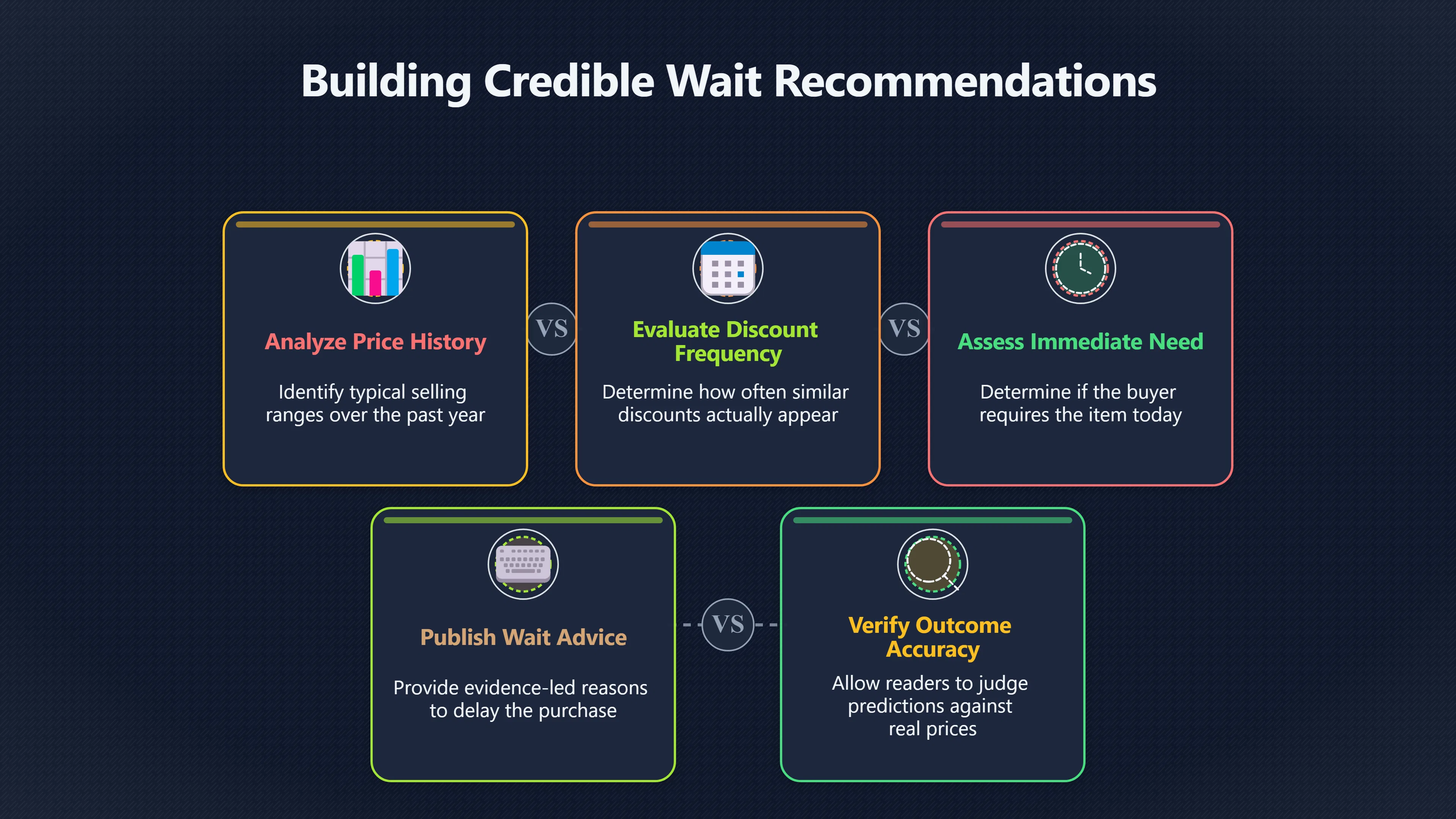
A stronger recommendation might include:
- the product’s typical selling range over the past year;
- the historical price that represents genuinely good value;
- how often similar discounts have appeared;
- whether stock shortages or seasonal demand could change the calculation;
- what would cause the recommendation to change.
For example:
“This laptop is currently £999. During the past year it has repeatedly fallen below £850 during major retailer promotions. Unless you need it immediately, waiting for a return to that range is likely to offer better value.”
The recommendation becomes testable. Readers can later judge whether the prediction proved accurate, making the site’s credibility accountable to observable outcomes.
Avoid turning “wait” into another sales tactic
Not every product should receive a wait recommendation. If readers notice that every page alternates mechanically between “buy now” and “wait”, the advice begins to feel manufactured rather than analytical.
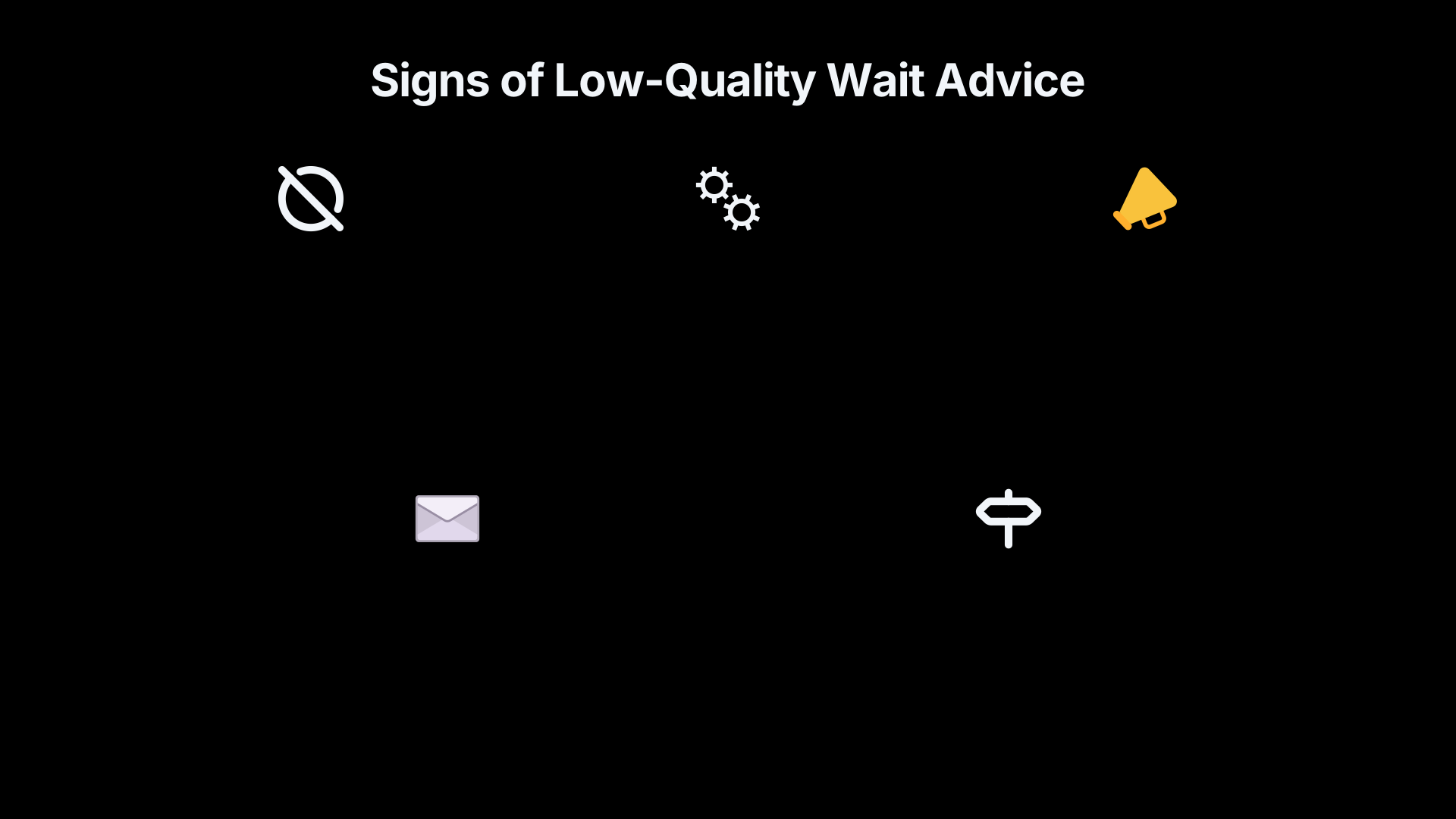
Signs that wait advice is being used primarily as a marketing device include:
- recommending readers wait without presenting any pricing evidence;
- repeatedly implying an imminent discount without historical support;
- using wait recommendations merely to encourage newsletter sign-ups or price alerts;
- reversing previous advice without explaining what changed.
Consistency matters more than frequency. Some products genuinely deserve immediate purchase recommendations because the current price is historically strong or because discounts are uncommon. Others deserve patience. The credibility comes from applying the same standards regardless of whether the outcome produces an immediate affiliate commission.
Why editorial restraint becomes a competitive advantage
Many affiliate pages treat urgency as the default: every discount is presented as exceptional and every visitor is encouraged to buy immediately. That creates a predictable trust problem because experienced shoppers know that prices fluctuate and promotions are often repeated.
Wait recommendations solve part of that problem by introducing visible editorial independence. They acknowledge uncertainty, recognise opportunity cost and place the reader’s financial outcome ahead of the publisher’s immediate earnings.
Within price history and cheaper alternative pages, this restraint is not a weakness. It is the feature that makes the page more valuable than a retailer listing or a generic affiliate review. When readers believe a publisher is willing to lose today’s commission in order to protect tomorrow’s advice, every future “buy now” recommendation carries more weight.
Amazon book picks
Further Reading
Books and field guides related to Why Saying Wait Can Win Trust. Use these as the next step if you want deeper reading beyond the article.
Everybody Writes
Shows how clear, reader-first writing improves credibility, including recommendation content that prioritizes audience outcomes.
The (Honest) Truth about Dishonesty
Provides insight into honesty, incentives, and conflicts of interest relevant to affiliate recommendations.
Trust Me, I'm Lying
Offers perspective on credibility, media incentives, and why transparent practices matter.
Influence: The Psychology of Persuasion
Explains how ethical persuasion and credibility influence decision-making, supporting the idea that restraint builds trust.
eBay marketplace picks
Marketplace Samples
Live-tested eBay searches with available results related to this page.


Endnotes
1.
Source: yellowgrape.io
Title: de toekomst van affiliate marketing na googles helpful content [updates]({{ ‘updates/’ | relative_url }})
Link:https://www.yellowgrape.io/en/insights/de-toekomst-van-affiliate-marketing-na-googles-helpful-content-updates
Source snippet
The future of affiliate marketing after Google's Helpful...24 Oct 2024 — As a result of these so-called Helpful Content updates, many af...
2.
Source: arxiv.org
Link:https://arxiv.org/abs/1809.00620
3.
Source: arxiv.org
Link:https://arxiv.org/abs/2603.04383
4.
Source: ftc.gov
Title: Federal Trade Commission FTC’s Endorsement Guides: What People Are Asking
Source snippet
Federal Trade CommissionFTC's Endorsement Guides: What People Are AskingSeptember 7, 2017 — 29 Jun 2023 — Here are answers to some of the...
Published: September 7, 2017
Additional References
5.
Source: zinfi.com
Link:https://www.zinfi.com/blog/affiliate-marketing-ultimate-success-guide/
Source snippet
Ultimate Guide to Affiliate Marketing Success and StrategiesUnlock affiliate marketing secrets with our in-depth guide. How to choose pro...
6.
Source: alidropship.com
Title: how to get started with affiliate marketing
Link:https://alidropship.com/how-to-get-started-with-affiliate-marketing/
Source snippet
Affiliate Marketing For Beginners: A Complete 2026 Guide21 Mar 2026 — Learn how to get started with affiliate marketing in 2026, from cho...
7.
Source: linkedin.com
Link:https://www.linkedin.com/pulse/do-ftc-affiliate-disclosures-activate-persuasion-knowledge-zncwf
Source snippet
· Gies College of Business - University of Illinois...Read more...
8.
Source: facebook.com
Link:https://www.facebook.com/WordPresscom/posts/hosting-affiliates-is-your-content-actually-ranking-or-just-existinghosting-is-o/1414350327406419/
Source snippet
Hosting is one of the most competitive affiliate niches online...
9.
Source: shopify.com
Title: Learn how affiliate disclosures ensure
Link:https://www.shopify.com/blog/affiliate-disclosure
Source snippet
Affiliate Disclosure Guide: How To Build Trust as an Affiliate22 May 2026 — An affiliate disclosure lets your audience know when your con...
Published: May 2026
10.
Source: wecantrack.com
Title: What Is an Affiliate Disclosure?
Link:https://wecantrack.com/insights/affiliate-disclosure/
Source snippet
Why You Need OneAn affiliate disclosure, or disclaimer, states that certain links on a website are affiliate links, informing users of yo...
11.
Source: youtube.com
Link:https://www.youtube.com/watch?v=nAnT8hE8ANM
Source snippet
How to Get Cited by AI for Affiliate Marketing...
12.
Source: youtube.com
Title: How To Write SEO Optimized Affiliate Review Posts FAST!
Link:https://www.youtube.com/watch?v=khLXlseXffs
Source snippet
DONT BUY a Logitech MX Master Mouse (if you have a new Mac)…...
13.
Source: youtube.com
Title: How To Be Successful With Affiliate Marketing
Link:https://www.youtube.com/watch?v=T6KQQ1NbdFg
Source snippet
How To Write SEO Optimized Affiliate Review Posts FAST...
14.
Source: youtube.com
Title: How to Get Cited by AI for Affiliate Marketing
Link:https://www.youtube.com/watch?v=fDmjfZ0G5sQ
Source snippet
How To Be Successful With Affiliate Marketing...
Topic Tree