Within Affiliate Pages
Should Affiliate Sites Chase Expensive Products?
Higher-priced products can earn more per sale, while low-cost items usually need much larger traffic volumes.
On this page
- Commission math by product price
- Conversion friction on high ticket offers
- When low cost products still work
Page outline Jump by section
Introduction
Should an affiliate site chase expensive products? Sometimes, but not simply because the commission looks bigger. High-ticket products can turn a small number of purchases into meaningful revenue, while low-cost products usually need much larger traffic volumes to produce the same result. The real decision is not “expensive good, cheap bad”; it is whether the site can attract readers with enough intent, trust, patience, and information to make a higher-priced purchase through an affiliate link.
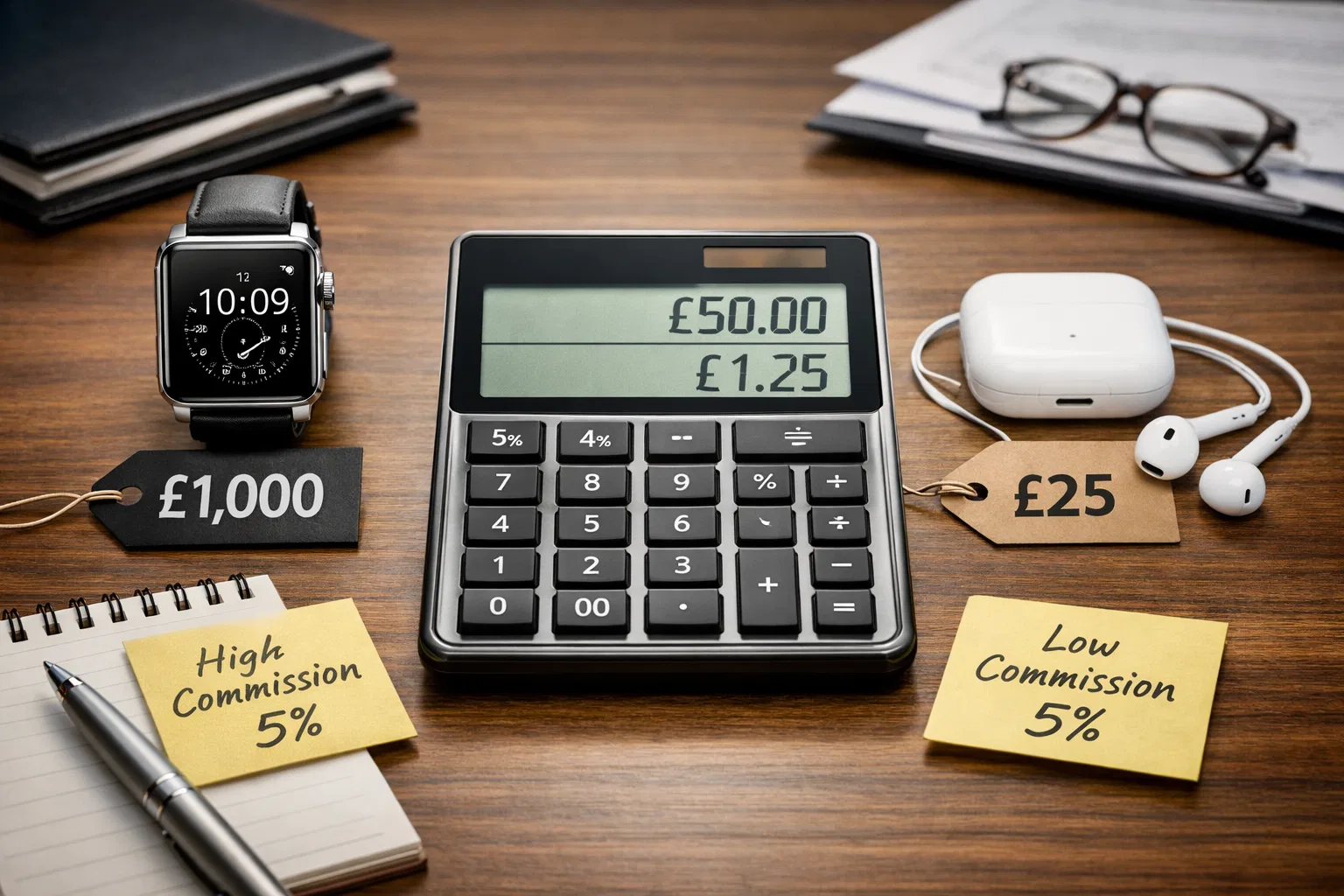
For a website built around affiliate links, ticket size changes the whole mechanism of earning. A £1,000 product at a 5% commission produces £50 before returns, cancellations, or attribution losses. A £25 product at the same rate produces £1.25. That difference is why high-ticket niches such as premium software, finance leads, luxury travel, specialist equipment, and business services tempt publishers. But higher prices also raise friction: buyers compare more, delay longer, worry more about risk, and expect stronger evidence before clicking “buy”. Low-cost products pay less per sale, but they can work when they fit frequent purchases, impulse demand, large audiences, or tightly focused buying guides.
The maths changes before the marketing does
Affiliate income is usually a multiplication problem: visitors, click-through rate, merchant conversion rate, product price, and commission rate. Ticket size affects only one part of that equation, but it can dominate the outcome. A low-cost product can convert well and still earn little if the commission per order is tiny. A high-ticket product can convert rarely and still justify the work if each successful referral is worth enough.
Amazon’s own Associates rate cards show why category and ticket size must be considered together. On Amazon UK, some categories such as clothing, luxury, shoes, handbags, wallets and watches are listed at 6%, while categories including books, furniture, home improvement, kitchen and dining, music, automotive, handmade and power tools are listed at 5%. The US Amazon Associates statement shows a different table, with luxury beauty and related categories at 10%, physical books and kitchen at 4.5%, and other categories lower depending on product type. These official tables matter because a £900 item at 1% may earn less than a £150 item at 6%.[Amazon Associates]amazon.co.uk6.0%Amazon AssociatesAssociates Program Standard Commission Income StatementAmazon Fashion Private Brands | Clothing & Accessories | Luxury |…
A useful comparison is to calculate earnings per completed sale, not just commission percentage:
- £30 product at 4%: £1.20 per sale.
- £150 product at 5%: £7.50 per sale.
- £1,000 product at 4%: £40 per sale.
- £8,000 booking at 4%: £320 before programme-specific rules, cancellations, and attribution limits.
That last example is not hypothetical as a category pattern. Awin’s guide to high-ticket affiliate marketing gives luxury villa rentals as an example where commission rates can start at 4% and average order values can be around £8,000. The point is not that every affiliate can rank for luxury travel; it is that order value can change the revenue ceiling of a single successful referral.[Awin]awin.comhigh ticket affiliate marketinghigh ticket affiliate marketing
The trap is treating a high-ticket commission as if it were guaranteed. Travel, for example, can involve completed-stay rules, cancellations, delayed payments, and programme-specific calculations. Booking.com’s affiliate support says partners earn a percentage of the revenue Booking.com earns for each reservation made through affiliate links, while CJ’s Booking.com programme page says rates start at 4% for completed accommodation stays, 6% for completed car rentals, 4% for attractions and a fixed £2 or €2 per flight. That means the affiliate is not always earning a simple percentage of the customer’s total basket in the way a beginner might assume.[Booking.com Affiliate Support]affiliates.support.booking.comCommission and PaymentsCommission and Payments
High-ticket products need more than high intent
A high-ticket affiliate page is rarely just a “best X” list with larger numbers attached. Expensive purchases create more doubt. A reader considering a £25 kitchen gadget may accept a quick comparison and some user reviews. A reader considering a £2,000 mattress, a £900 camera lens, a £4,000 family holiday, or a £300-a-month software contract usually wants to understand risk, alternatives, warranties, returns, compatibility, hidden costs and who the product is not right for.
Checkout research helps explain the friction. Baymard Institute’s cart-abandonment data puts the average abandonment rate at about 70%, and its survey of checkout reasons lists extra costs, slow delivery, lack of trust with credit card details, forced account creation, complicated checkout, weak returns policy and unclear total cost among the leading causes of abandonment. These are not affiliate-specific problems, but high-ticket affiliate sites are exposed to them because expensive purchases magnify every source of hesitation.[Baymard Institute]baymard.comOpen source on baymard.com.
For that reason, high-ticket affiliate content has to reduce perceived risk before it sends the reader away. The most useful pages often include:
- real comparison criteria, such as total cost, warranty terms, cancellation rules, service limits, dimensions, integrations, upgrade paths, or long-term running costs;
- evidence of use or expertise, such as original testing, screenshots, worked examples, measurements, or long-term ownership notes;
- clear disqualification, explaining who should avoid the product rather than pretending every expensive option is the best;
- merchant-risk context, including returns, support quality, delivery constraints, trial periods, lock-in, and payment terms.
This is also where search quality rules matter commercially. Google’s spam policies warn against “thin affiliate” pages that exist mainly to send users elsewhere without adding meaningful value. A site chasing high commissions with rewritten merchant descriptions is especially vulnerable because the reader’s decision is high-stakes and the page’s added value is low.[Google for Developers]developers.google.comOpen source on google.com.
Low-cost products still work when volume and usefulness align
Low-cost affiliate products are not automatically weak. They simply rely on a different mechanism. Instead of needing a few large sales, the site needs enough repeatable demand, enough search volume, enough click-throughs, and enough conversion volume to make small commissions add up. This can work well when the product category is broad, replenishable, giftable, seasonal, or part of a larger basket.
Amazon-style retail affiliate sites are the obvious example. A page about affordable kitchen tools, beginner craft supplies, phone accessories, books, toys, pet items, or small home-improvement parts may not earn much per purchase, but the reader may buy quickly because the risk is low. Amazon also has a conversion advantage in many markets because readers already trust the checkout, delivery, returns, and saved payment details. Amazon UK promotes its Associates programme as offering up to 12% in commission income from qualifying purchases and programmes, although the actual category rates vary widely.[Amazon Associates]amazon.co.ukAmazon Associates Amazon.co.uk Associates Central Earn up to 12 % in commissions income from qualifying purchases and programs. Our compeAmazon Associates Amazon.co.uk Associates Central Earn up to 12 % in commissions income from qualifying purchases and programs. Our compe
Low-cost products can also benefit from basket effects. A reader might click for a £12 item and buy several related products, or buy something else during the eligible session depending on programme rules. That does not remove the need for good content, but it means a low-ticket page can earn from convenience and proximity to purchase rather than from a long persuasion process.
The best low-cost affiliate sites often win by being specific. “Best coffee machine” is brutally competitive and often pushes towards higher-priced products. “Best replacement milk frothing jug for a small espresso machine” is narrower, lower-ticket, and more useful to someone with a precise problem. The commission is smaller, but the intent can be cleaner.
The historical shift: from volume pages to trust pages
The high-ticket versus low-cost decision has changed because the affiliate web itself has changed. Earlier affiliate websites could often rely on search volume, keyword targeting and lightweight product round-ups. As competition grew and search engines became more aggressive about thin commercial content, the model shifted towards trust, evidence and usefulness.
Google’s policies now explicitly include affiliate-style pages in the broader problem of spam when they add little value, and the company has also tightened policies around site reputation abuse, where unrelated third-party commercial pages exploit the authority of a stronger domain. Reporting on Google’s crackdown has repeatedly highlighted coupon pages and affiliate-style product recommendations as examples of the wider quality problem.[Google for Developers]developers.google.comOpen source on google.com.
This history matters because high-ticket products are often presented online as a shortcut: fewer sales, larger payouts, faster income. In practice, they usually demand more authority. A beginner can publish a page about a £20 accessory and still be useful by clarifying fit, dimensions, or compatibility. A beginner publishing financial, software, medical-adjacent, legal-adjacent, or luxury-purchase recommendations faces a harder credibility gap. The commission is higher because the sale is harder, the customer is more valuable, or the merchant margin can support a larger payout.
At the same time, low-cost affiliate sites are no longer safe just because the items are harmless or familiar. A thin page listing ten cheap products with copied images and generic blurbs is still thin. The sustainable distinction is not ticket size; it is whether the page gives the reader a reason to trust the recommendation before leaving the site.
Conversion friction is different at each price point
A low-cost product tends to face practical friction: is it the right size, will it arrive quickly, is the rating acceptable, does it solve the problem now? A high-ticket product faces strategic friction: is this the right provider, is there a cheaper alternative, what happens if it fails, am I being locked in, should I wait, should I ask someone else?
That difference affects the type of affiliate page that works.
For low-cost products, the page can often help by narrowing choice quickly. Useful formats include “best under £50”, “best for small flats”, “compatible with this model”, “cheap but durable”, “replacement parts”, “gift ideas”, and “what to buy first”. The reader’s burden is selection, not deep conviction.
For high-ticket products, the page must support a longer decision. Useful formats include comparison tables with transparent criteria, total-cost breakdowns, product-versus-product pages, “who should buy this” sections, alternatives by budget, cancellation and warranty explanations, and examples of real use. In software, that might mean comparing monthly price, annual discount, seat limits, support tiers, integrations and migration costs. In travel, it might mean explaining deposit rules, family suitability, location trade-offs and cancellation terms. In specialist equipment, it might mean maintenance, parts availability, safety, training and resale value.
The same traffic number can therefore mean different things. Ten thousand monthly visits to low-intent informational content about a luxury category may be worth less than 800 visits to a detailed comparison page for people choosing between two paid software plans. Conversely, a low-cost product page can outperform a high-ticket page if it catches a large number of ready-to-buy readers and sends them to a merchant that converts efficiently.
When expensive products are worth chasing
A high-ticket affiliate strategy makes sense when the site can credibly answer the questions that stand between the reader and the purchase. The better the site is at reducing uncertainty, the more realistic the high-ticket path becomes.
High-ticket offers are most attractive when several conditions line up:[awin.com]awin.comhigh ticket affiliate marketinghigh ticket affiliate marketing
- The reader has strong commercial intent. Searches such as “best CRM for small law firms”, “X versus Y accounting software”, “best travel insurance for over-70s”, or “best camera lens for weddings” are closer to purchase than broad educational searches.
- The commission is high in cash terms, not just percentage terms. A 20% commission on a £40 digital product is still £8; a 4% commission on a £2,000 purchase is £80.
- The site can provide evidence the merchant cannot. This may include independent testing, honest drawbacks, comparison across brands, or experience from a specific use case.
- The programme terms are stable enough to build around. Cookie duration, approval rules, cancellation treatment, payment delay, prohibited traffic sources and commission changes all affect the real value of a high-ticket niche.
- The niche rewards trust rather than only price. Premium software, professional tools, financial leads, high-end travel and specialist equipment often require more explanation than commodity retail.
The risk is concentration. A high-ticket affiliate site can look healthy while depending on a few pages, a few merchants, or a few conversions per month. One commission cut, one search ranking drop, one programme closure, or one merchant conversion problem can remove a large share of income. That is why high-ticket sites often need more careful tracking and more diversified merchant relationships than low-cost sites.
When low-cost products are the smarter choice
Low-cost products are often better for new or highly practical sites because they let the publisher learn what readers click and buy without needing to persuade someone through a major purchase. They can also fit sites where the reader’s main need is convenience rather than deep advice.
Low-cost affiliate products work especially well when:
- the audience is large enough to compensate for small commissions;
- the products are bought frequently, such as consumables, accessories, refills, replacement parts, books, hobby supplies, or seasonal items;
- the purchase is low-risk, so readers can decide quickly;
- the content solves a specific problem, such as compatibility, sizing, setup, maintenance, or “what fits with what”;
- the merchant has strong conversion infrastructure, such as trusted checkout, fast delivery, easy returns and broad stock.
A low-cost strategy can also be more editorially flexible. A site about home coffee, for example, might earn from inexpensive cleaning tablets, milk jugs, scales, filters and books while also building authority for higher-ticket machines later. A gardening site might start with gloves, hand tools and replacement parts before moving into mowers, sheds or irrigation systems. The low-cost products do not have to be the end state; they can be part of a trust-building path.
The danger is traffic dependency. If each sale earns only pennies or a few pounds, the site may need tens or hundreds of thousands of monthly visitors to reach meaningful income. That pushes the publisher towards search-engine dependence, high content output, and constant competition over product-round-up keywords.
The middle ticket is often overlooked
Many durable affiliate sites live in the middle rather than at either extreme. Mid-ticket products — perhaps £75 to £500 depending on the niche — can offer enough commission to matter while still being affordable enough for readers to buy without weeks of deliberation. Examples include small appliances, quality tools, home-office equipment, hobby gear, luggage, pet equipment, fitness accessories, and prosumer software.
This middle ground often has the best balance of commission, conversion and content usefulness. The reader still needs help choosing, but the decision is not so intimidating that every click becomes a long sales cycle. The affiliate can produce genuinely useful comparisons without needing the authority burden of a financial adviser, enterprise software consultant, or luxury travel specialist.
A mid-ticket page can also support internal linking naturally. A site might compare beginner products, explain upgrades, review accessories, and then point readers towards premium options only when their use case justifies it. That is usually healthier than forcing every page towards the highest commission available.
A practical decision rule for affiliate sites
The simplest way to choose between high-ticket and low-cost products is to model the page backwards from realistic behaviour. Do not begin with “this product pays £200”. Begin with the reader’s hesitation and the site’s ability to overcome it.
A practical decision cluster looks like this:
- Estimate cash commission per sale. Use actual programme terms, not headline claims. Include category rates, completed-sale rules, lead qualification, refund periods and payment delay.
- Estimate likely conversion difficulty. Ask how many comparisons, objections and trust signals the buyer needs before purchase.
- Assess content advantage. Decide whether the site can provide original insight, hands-on testing, specialist knowledge, or unusually clear comparison.
- Check traffic realism. A low-cost page needs volume; a high-ticket page needs intent. Both are hard, but in different ways.
- Check downside exposure. High-ticket income can be lumpy and programme-dependent; low-cost income can be fragile if search traffic falls.
- Match format to decision stage. Use quick selectors and compatibility guides for low-cost items; use deeper comparison, risk reduction and total-cost analysis for high-ticket offers.
This approach prevents a common beginner mistake: comparing only commission size while ignoring conversion friction. A £300 commission that never converts is worth less than a £4 commission earned hundreds of times. A £1 commission on a page with no traffic is also worth nothing. Ticket size is powerful only when it fits the reader’s intent and the site’s credibility.
The balanced answer
Affiliate sites should not blindly chase expensive products. They should chase the product tier where they can create the most trusted, purchase-useful page relative to the competition. High-ticket products can produce far more revenue per conversion, but they demand stronger evidence, deeper comparison, better trust signals and tolerance for longer buying cycles. Low-cost products need more traffic, but they can convert quickly and work well for practical, specific, repeatable buying problems.
The best affiliate strategy often combines both. Low-cost and mid-ticket content can build topical authority, capture frequent searches, and serve readers with immediate needs. High-ticket pages can then monetise the most serious decision-stage traffic, provided the site has earned enough trust to deserve the click. The core question is not whether expensive products pay more. They often do. The question is whether the website can honestly help a cautious buyer make a higher-stakes decision better than the merchant, a marketplace listing, or a generic comparison page.
Amazon book picks
Further Reading
Books and field guides related to Should Affiliate Sites Chase Expensive Products?. Use these as the next step if you want deeper reading beyond the article.
Affiliate Program Management
Directly covers affiliate economics, commissions, programmes and publisher strategy.
Dotcom Secrets
Relevant to improving conversions and customer value rather than chasing price alone.
The 1-Page Marketing Plan
Helps readers evaluate profitable offers, positioning and customer acquisition.
Traffic Secrets
Explains attracting qualified buyers, essential for higher-ticket affiliate sales.
eBay marketplace picks
Marketplace Samples
Live-tested eBay searches with available results related to this page.

Endnotes
1.
Source: affiliate-program.amazon.com
Link:https://affiliate-program.amazon.com/help/node/topic/GRXPHT8U84RAYDXZ?tag=searcht-20
Source snippet
Amazon AssociatesStandard Commission Income RatesTable 1 – Fixed Standard Commission Income Rates for Specific Product Categories; Digit...
2.
Source: awin.com
Title: high ticket affiliate marketing
Link:https://www.awin.com/gb/affiliate-marketing/high-ticket-affiliate-marketing
3.
Source: affiliates.support.booking.com
Title: Commission and Payments
Link:https://affiliates.support.booking.com/kb/s/article/Commission-and-Payments
4.
Source: baymard.com
Link:https://baymard.com/research/checkout-usability
5.
Source: baymard.com
Title: cart abandonment rate
Link:https://baymard.com/lists/cart-abandonment-rate
6.
Source: developers.google.com
Link:https://developers.google.com/search/docs/essentials/spam-policies
7.
Source: affiliate-program.amazon.com
Link:https://affiliate-program.amazon.com/help/node/topic/G4ARBJC7Z2NK48CA?tag=searcht-20
8.
Source: baymard.com
Title: ecommerce checkout usability report and benchmark
Link:https://baymard.com/blog/ecommerce-checkout-usability-report-and-benchmark
9.
Source: baymard.com
Title: current state of checkout ux
Link:https://baymard.com/blog/current-state-of-checkout-ux
10.
Source: baymard.com
Link:https://baymard.com/learn/reduce-cart-abandonment
11.
Source: baymard.com
Title: Ecommerce Checkout UX Guide
Link:https://baymard.com/learn/checkout-flow-ux-optimization
12.
Source: baymard.com
Link:https://baymard.com/blog/collections/cart-and-checkout
13.
Source: support.google.com
Link:https://support.google.com/webmasters/answer/9044175?hl=en
14.
Source: booking.com
Link:https://www.booking.com/affiliate-program/v2/index.html
15.
Source: awin.com
Title: what the cap code means for affiliates
Link:https://www.awin.com/gb/compliance-and-regulations/what-the-cap-code-means-for-affiliates
16.
Source: affiliate-program.amazon.co.uk
Link:https://affiliate-program.amazon.co.uk/help/node/topic/GRXPHT8U84RAYDXZ?tag=searcht-20
Source snippet
Amazon AssociatesAssociates Program Standard Commission Income StatementAmazon Fashion Private Brands | Clothing & Accessories | Luxury |...
17.
Source: affiliate-program.amazon.co.uk
Link:https://affiliate-program.amazon.co.uk/?tag=searcht-20
18.
Source: asa.org.uk
Title: affiliate marketing
Link:https://www.asa.org.uk/advice-online/affiliate-marketing.html
19.
Source: affiliate-program.amazon.co.uk
Link:https://affiliate-program.amazon.co.uk/help/operating/policies?tag=searcht-20
20.
Source: alidropship.com
Title: amazon associates affiliate program
Link:https://alidropship.com/amazon-associates-affiliate-program/
Additional References
21.
Source: youtube.com
Link:https://www.youtube.com/watch?v=1y1NvFkXZe4
Source snippet
High Ticket vs Low Ticket Affiliate Marketing (The Surprising Truth)...
22.
Source: youtube.com
Title: STOP with Amazon Affiliates if You ACTUALLY Want to Make Money Online
Link:https://www.youtube.com/watch?v=_T-2qHoLI5U
Source snippet
High Ticket Vs Low Ticket Residual [Affiliate Commissions]({{ 'disclosure-967c81/' | relative_url }})| Affiliate Marketing for Beginners...
23.
Source: youtube.com
Title: High Ticket vs Low Ticket Affiliate Marketing (The Surprising Truth)
Link:https://www.youtube.com/watch?v=Qi-vItLJcdA
Source snippet
How to ACTUALLY Make Your First $1,000 with High Ticket Affiliate Marketing... Works in 2026...
24.
Source: youtube.com
Title: High Ticket vs Low Ticket Affiliate Marketing
Link:https://www.youtube.com/watch?v=Qdwjs0i5FRI
Source snippet
STOP with Amazon Affiliates if You ACTUALLY Want to Make Money Online...
25.
Source: wecantrack.com
Link:https://wecantrack.com/insights/affiliate-commission-statistics/
26.
Source: researchgate.net
Link:https://www.researchgate.net/publication/380508657_The_Impact_of_Online_Reviews_on_Consumers%27_Purchase_Intentions_Examining_the_Social_Influence_of_Online_Reviews_Group_Similarity_and_Self-Construal
27.
Source: buyapowa.com
Link:https://www.buyapowa.com/blog/88-of-consumers-trust-word-of-mouth/
28.
Source: wecantrack.com
Link:https://wecantrack.com/insights/affiliate-program-performance-statistics/
29.
Source: totalproductmarketing.com
Link:https://totalproductmarketing.com/marketing-insights/conversion-rate-affiliate-marketing-all-industries/
30.
Source: webeyez.com
Link:https://webeyez.com/insights/guides/baymard-checkout-abandonment-optimization
Topic Tree
Follow this branch
Parent topic
Affiliate PagesRelated pages 29
- Amazon Is Amazon Associates Still Good for Beginners?
- Appliances What Kitchen Appliance Reviews Often Miss
- Authority Can Expertise Beat Bigger Affiliate Sites?
- Baby Travel Why Baby Travel Gear Reviews Need More Trust
- Business Tools Can Small Business Software Be a Better Affiliate Niche?
- +24 more in sidebar