Within SEO Guides
Which Page Format Fits the Buyer?
A buying guide works better when its format matches whether the reader wants a shortlist, a comparison, a review, or a value judgement.
On this page
- Best for, versus, review, and worth it queries
- How the opening answer should change by intent
- Common format mismatches that lose trust
Page outline Jump by section
Introduction
The most effective affiliate buying guides do not start with a product list. They start with the buyer’s intent. Someone searching for “best”, “vs”, “review”, or “is it worth it?” is trying to solve a different decision, even when the product is the same. Matching the page format to that decision helps readers find their answer more quickly, increases trust, and improves the likelihood that the page satisfies both users and search engines. Google’s guidance for product reviews explicitly encourages content that helps readers make decisions through meaningful comparisons, evidence, and explanations rather than generic affiliate summaries.[Elementor]elementor.comAffiliate Marketing SEO: 10 Actionable Tips to Drive RealFocus on terms that signal a user is ready to buy, such as “best [product],” “[…Read more…
 For affiliate publishers, this means choosing the right page structure before writing. A comparison page should not behave like a review, and a buying guide should not read like a collection of unrelated product descriptions. When the page format matches the question behind the search, readers spend less effort translating the content into a buying decision and more time evaluating the recommendation itself.
Which queries deserve which page format?
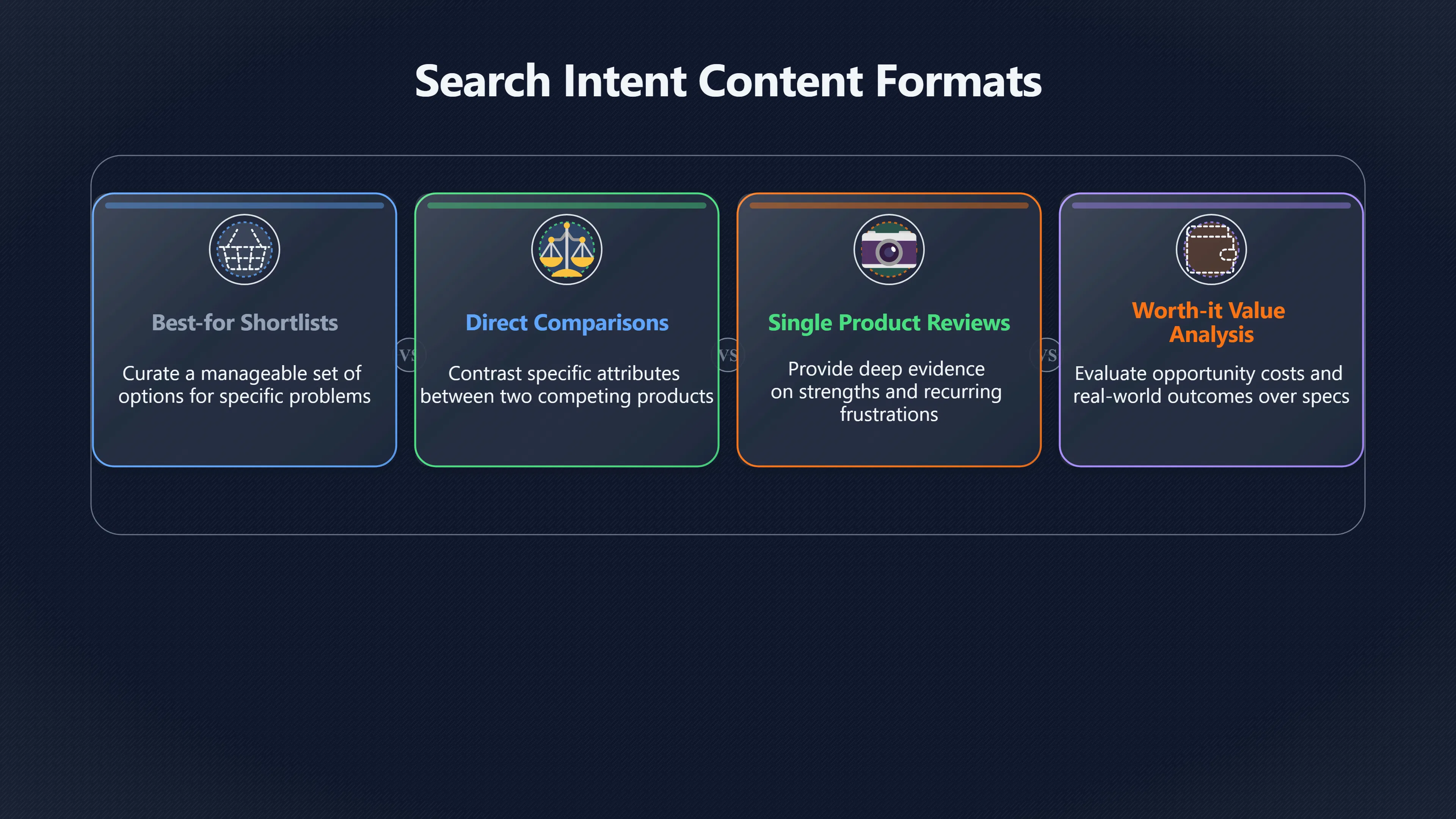
Commercial search intent is not a single category. Different query patterns reveal different stages of decision-making, and each stage benefits from a distinct content format.
Query patternReader’s real questionBest page formatPrimary objectiveBest…Which few products should I consider?Shortlist or buying guideNarrow many options into a manageable setProduct A vs Product BWhich of these two should I buy?Head-to-head comparisonResolve trade-offs between specific alternativesProduct reviewIs this particular product good enough?Single-product reviewBuild confidence or identify deal-breakersIs it worth it?Does the extra cost justify the benefits?Value analysisHelp readers judge return on investment
Although all four pages may recommend the same product, the reader expects different evidence from each. Trying to satisfy every intent on one page usually produces content that feels unfocused.
Best-for, versus, review and worth-it queries
Best-for searches need fast filtering
A query such as “best office chair for back pain” is not asking for exhaustive coverage of every chair on the market. The reader wants a curated shortlist organised around a specific problem.
The opening should answer immediately:
For most people with lower-back discomfort, Product X is the strongest overall choice because it balances support, adjustability and price. If your priority is long working sessions or a tighter budget, consider Products Y or Z instead.
After that, the guide can explain:
- why each recommendation exists
- who should avoid it
- the trade-offs between price and features
- how the products were selected
Readers should understand why the list is limited. Ten carefully justified recommendations often serve intent better than fifty lightly described options. Google’s review guidance similarly encourages explaining why one product is best for a particular use case rather than making unsupported “best overall” claims.[Elementor]elementor.comAffiliate Marketing SEO: 10 Actionable Tips to Drive RealFocus on terms that signal a user is ready to buy, such as “best [product],” “[…Read more…
Versus searches need direct comparison
A “Product A vs Product B” search reflects a much narrower decision. The buyer has already shortlisted products.
Instead of lengthy introductions, begin by answering the comparison.
For example:[seranking.com]seranking.comSE RankingThe 6 Types of Search Intent (Including the New…February 12, 2026 — Search intent (also called user, audience, or keyword in…
- Which performs better?
- Which costs less over time?
- Which buyer should choose each product?
Comparison tables work well here because readers are evaluating differences rather than discovering products.
Each comparison section should examine the same attribute:
- performance
- ease of use
- durability
- warranty
- ongoing costs
- value
Avoid introducing unrelated products unless they genuinely solve a gap neither option addresses.
Review searches need evidence
Someone searching for a review has usually passed the discovery stage.
The question becomes:
Should I actually buy this?
A review should therefore concentrate on one product rather than repeatedly comparing multiple alternatives.
Useful sections include:
- real strengths
- recurring frustrations
- who should buy it
- who should not
- what changed from previous models
- whether competitors outperform it in specific situations
Readers expect depth rather than breadth. Original testing, photographs, measurements, or clearly explained evaluation methods strengthen credibility because they demonstrate experience rather than simply repeating manufacturer specifications.[Elementor]elementor.comAffiliate Marketing SEO: 10 Actionable Tips to Drive RealFocus on terms that signal a user is ready to buy, such as “best [product],” “[…Read more…
Worth-it searches need value judgement
“Is it worth it?” is rarely about features alone.
Instead, buyers are evaluating opportunity cost.
Examples include:
- Is the premium version worth another £200?
- Is the latest model worth replacing the previous one?
- Is a subscription worth paying annually?
These pages should focus on outcomes rather than specifications.
A useful structure is:
- Direct answer.
- Who gains enough value to justify the price.
- Who probably should save money.
- Situations where spending more makes little practical difference.
Readers often appreciate honest recommendations not to spend more when additional features offer limited real-world benefit.

How the opening answer should change by intent
The first few paragraphs determine whether readers believe the page understands their question.
Different intents require different openings.
Buying guide (“best”)
Lead with the overall recommendation, then identify the main alternatives for different needs.
Readers want orientation before detail.
Comparison (“vs”)
State which option wins under which circumstances.
Do not begin with product histories or company backgrounds.
Review
Summarise the overall verdict.
Readers should know whether the product is recommended before reading several thousand words.
Worth-it page
Answer the value question immediately.
Readers are looking for justification, not suspense.
Across all four formats, avoid forcing users to scroll through affiliate disclosures, lengthy introductions or generic buying advice before receiving the answer they searched for.
Common format mismatches that lose trust
Many affiliate pages fail because they force one template onto every keyword.
Common examples include:
A buying guide disguised as a review
The title promises a review but the page mostly lists competing products.
Readers looking for detailed evaluation leave disappointed.
A comparison that never compares
Some “vs” pages describe Product A for several hundred words, then Product B for several hundred more, without directly contrasting them.
Readers must perform the comparison themselves.
A shortlist without recommendations
Some “best” articles describe every product equally.
If every option appears equally suitable, the page has failed to reduce decision complexity.
A review that avoids negatives
Readers expect weaknesses.
Reviews containing only praise resemble advertisements rather than buying advice.
A worth-it article that repeats specifications
Value depends on outcomes.
Repeating feature lists without discussing whether buyers benefit from those features rarely answers the actual question.
These mismatches often increase dissatisfaction because users arrived expecting one decision framework and received another instead. Modern SEO guidance consistently emphasises satisfying the dominant search intent rather than simply targeting matching keywords.[SE Ranking]seranking.comSE RankingThe 6 Types of Search Intent (Including the New…February 12, 2026 — Search intent (also called user, audience, or keyword in…
A practical workflow for choosing the right format
Before drafting an affiliate page, identify the decision the reader is trying to make.
A practical sequence is:
- Read the target query literally.
- Identify the decision still unresolved.
- Choose the page format that naturally resolves that decision.
- Write the introduction as a direct answer.
- Include only the sections that help readers complete that decision.
This approach often removes unnecessary content instead of adding more.
For example:[seranking.com]seranking.comSE RankingThe 6 Types of Search Intent (Including the New…February 12, 2026 — Search intent (also called user, audience, or keyword in…
- “Best beginner DSLR” needs filtering.
- “Canon R10 vs Sony A6400” needs comparison.
- “Canon R10 review” needs evaluation.
- “Is the Canon R10 worth upgrading to?” needs a cost-versus-benefit judgement.
Although these pages may overlap internally through sensible linking, each should remain focused on resolving the specific purchase question that brought the visitor there.
Matching format improves both usability and affiliate performance
Affiliate pages succeed when they reduce uncertainty at the exact stage where a buyer hesitates. The closer the page structure matches that hesitation, the easier it becomes for readers to make a confident decision.
Rather than treating every commercial keyword as another opportunity for a generic listicle, match the format to the buyer’s intent. A shortlist should simplify choice, a comparison should clarify differences, a review should establish confidence, and a worth-it page should justify value. When each format stays true to its purpose, readers receive faster answers, trust grows naturally, and affiliate recommendations become more useful rather than merely more visible.
Amazon book picks
Further Reading
Books and field guides related to Which Page Format Fits the Buyer?. Use these as the next step if you want deeper reading beyond the article.
Everybody Writes
Helps writers match content structure and messaging to audience intent, aligning closely with buyer-focused page formats.
They Ask, You Answer
Focuses on creating content that directly answers buyer questions at different stages of purchase intent.
The Art of SEO
Provides strategic guidance on search intent and structuring pages for users and search engines.
Influence: The Psychology of Persuasion
Explains the decision-making principles behind effective comparison, review, and buying content.
eBay marketplace picks
Marketplace Samples
Live-tested eBay searches with available results related to this page.


Endnotes
1.
Source: elementor.com
Title: Affiliate Marketing SEO: 10 Actionable Tips to Drive Real
Link:https://elementor.com/blog/affiliate-marketing-seo/
Source snippet
Focus on terms that signal a user is ready to buy, such as “best [product],” “[...Read more...
2.
Source: rankmath.com
Title: search intent
Link:https://rankmath.com/blog/search-intent/
Source snippet
in 2026: A Comprehensive GuideIn this post, learn about the search intent and optimize your posts for higher [rankings]({{ 'rankings/' | relative_url }})...
3.
Source: seranking.com
Link:https://seranking.com/blog/search-intent/
Source snippet
SE RankingThe 6 Types of Search Intent (Including the New...February 12, 2026 — Search intent (also called user, audience, or keyword in...
Published: February 12, 2026
Additional References
4.
Source: seobility.net
Link:https://www.seobility.net/en/blog/search-intent-optimization/
Source snippet
Search Intent Optimization: An Actionable Guide5 Jun 2025 — Optimizing for intent has become one of the most important challenge...
5.
Source: youtube.com
Link:http://www.youtube.com/watch?v=CRv9BsRGpNw
Source snippet
Search intent affiliate marketing page format types Give me 8 Minutes and You'll Win at SEO in 2025 Ahrefs...
6.
Source: rankmax.com.au
Title: Search Intent: Understanding User Intent for SEO
Link:https://www.rankmax.com.au/articles/search-intent
Source snippet
21 Mar 2026 — Learn what search intent is, the 4 types, and how to optimise content for search intent in both Google and AI search...
7.
Source: artemis.marketing
Title: a beginners guide to search intent
Link:https://artemis.marketing/blog/a-beginners-guide-to-search-intent/
Source snippet
A Beginner's Guide to Search Intent6 Aug 2025 — Search intent refers to the reason behind a search query. It defines and categorises what...
8.
Source: youtube.com
Link:http://www.youtube.com/watch?v=VPDe8XL7Mh8
Source snippet
Using Keyword Research and Searcher Intent: The Secret In Attracting Qualified Buyers...
9.
Source: tank.co.uk
Title: understanding search intent
Link:https://tank.co.uk/understanding-search-intent/
Source snippet
Search Intent SEO Guide: Types, Examples & Strategy25 Oct 2025 — Why is search intent the key to SEO? Learn how to master informational...
10.
Source: youtube.com
Title: How To Match Search Intent
Link:http://www.youtube.com/watch?v=cvdHc7wwEuc
Source snippet
SEO in 2025: How to Use Keyword Search Intent for SEO Success...
11.
Source: youtube.com
Title: Decode Your Visitors’ Search Intent
Link:https://www.youtube.com/watch?v=NlN7qqmCSDI
Source snippet
How to Boost Your...00:00 - Introduction; 01:19 - Customer Journey; 01:47 - Search Intent; 03:33 - Customer Journey + Search Intent...
12.
Source: digistore24.com
Title: affiliate marketing product reviews
Link:https://www.digistore24.com/en/blog/affiliate-marketing-product-reviews/
Source snippet
The best review shows the reader how...Read more...
13.
Source: youtube.com
Link:http://www.youtube.com/watch?v=6qjBTOSgbDI
Source snippet
This is why SEARCH INTENT is so important in SEO...
Topic Tree