Within Traffic
Can Price Alerts Bring Affiliate Readers Back?
Price alerts give readers a practical reason to return when timing matters as much as product choice.
On this page
- When price tracking fits the niche
- How alerts support trust without spamming readers
- Disclosure and deal quality rules
Page outline Jump by section
Introduction
Price-drop alerts can be one of the most effective ways to bring affiliate readers back to a website because they solve a real buying problem: many visitors are interested in a product but are not yet willing to pay today’s price. Instead of hoping those readers remember the site weeks later, a price alert gives them a practical reason to return when the product reaches their target budget.
 Unlike general newsletters, price alerts are tied to a specific purchasing intention. Readers have already identified a product or category they want, and the alert simply helps them act at the right moment. For affiliate publishers, this creates repeat visits, reinforces trust through ongoing usefulness, and increases the chance that the eventual purchase happens through an affiliate referral rather than through a later search or a competing website.
When Price Tracking Fits the Niche
Price alerts are most valuable where prices fluctuate regularly or buyers commonly delay purchases. Categories that benefit include:
- Consumer electronics and computer hardware.
- Cameras and photography equipment.
- Home appliances.
- Power tools.
- Premium software with recurring discounts.
- Outdoor and sporting equipment.
- Gaming hardware and accessories.
These purchases often involve research followed by a waiting period. Readers compare products, establish a budget, and postpone buying until a sale appears. A simple review article may only receive one visit, but a price alert creates an ongoing relationship until the buying decision is complete.
The mechanism is less useful for products with stable pricing, consumables purchased immediately, or low-cost impulse purchases where waiting offers little financial benefit.
Why Price Alerts Generate Repeat Traffic
The value is not merely the email itself. The mechanism works because it changes how readers interact with the site.
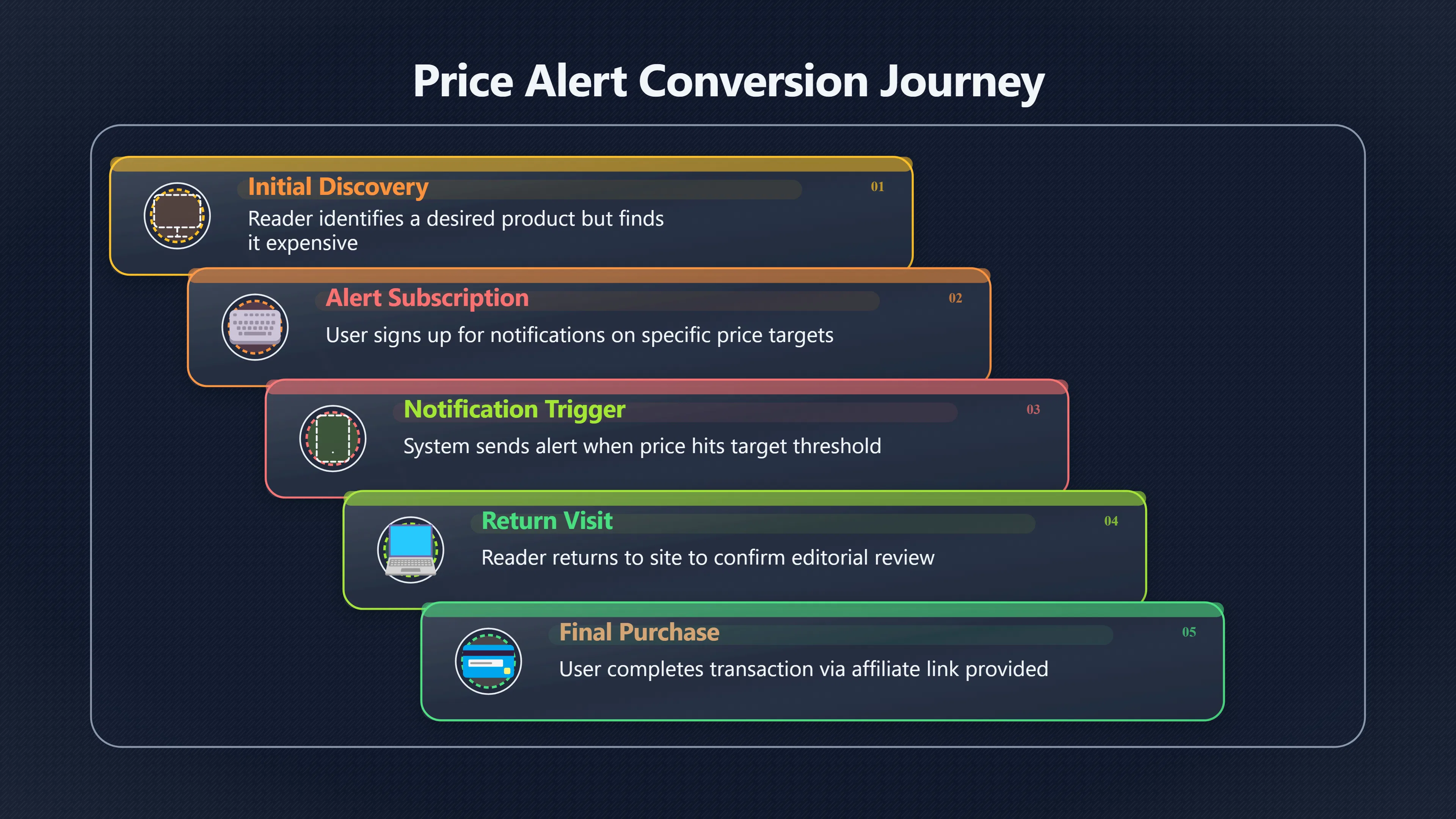
A typical journey looks like this:
- A reader arrives from search or social media.
- They decide a product is suitable but too expensive.
- They subscribe to a price alert.
- The publisher notifies them when the price genuinely drops.
- The reader returns to confirm the recommendation before purchasing.
That return visit often produces additional page views. Readers may revisit comparison tables, read updated reviews, check alternative products or discover related buying guides before clicking an affiliate link.
This differs from promotional newsletters, where readers may receive dozens of unrelated offers. A targeted alert arrives because the subscriber requested information about one specific purchase, making it more relevant and more likely to be opened.
How Alerts Support Trust Without Spamming Readers
Price alerts only work when readers believe they are designed to help rather than to maximise affiliate clicks.
Several practices strengthen that trust.
Alert Only for Meaningful Changes
Sending an email every time a product changes by £1 quickly trains subscribers to ignore future messages.
Instead, define meaningful thresholds, such as:
- A percentage reduction.
- A historically low price.
- A price below a user-selected target.
- A retailer promotion that rarely occurs.
Readers appreciate alerts that save genuine money rather than simply generating traffic.
Allow Readers to Control Frequency
Some buyers want immediate notifications.
Others prefer:
- Daily summaries.
- Weekly deal roundups.
- Alerts only for major discounts.
Giving subscribers control reduces unsubscribes and improves long-term engagement.
Explain Why the Deal Matters
Rather than writing:
“Product X is now on sale.”
Provide context such as:
- whether the discount is unusually large;
- whether the price matches previous seasonal lows;
- whether stock is limited;
- whether a competing product now represents better value.
Price history tools such as Keepa and CamelCamelCamel illustrate how historical pricing helps distinguish genuine bargains from routine promotions. Their popularity demonstrates that many shoppers care about price trends rather than today’s figure alone.[Keepa]keepa.comAmazon Price TrackerKeepa tracks over 5 billion Amazon products. We provide Amazon price history charts and price drop alerts…
Price Alerts Work Best Alongside Buying Advice
A useful alert usually sends readers back to editorial content rather than directly to a merchant.
For example, instead of linking only to a retailer, the alert can return readers to:
- an updated review;
- a comparison between competing models;
- a compatibility guide;
- an explanation of whether the discount changes the recommendation.
This reinforces the publisher’s role as an adviser rather than merely a source of affiliate links.
It also allows recommendations to evolve. A product that was poor value at full price may become an excellent recommendation after a substantial discount, while another may still be overpriced despite being “on sale.”

Disclosure and Deal-Quality Rules
Affiliate trust depends heavily on transparency.
Readers should always understand that:
- affiliate commissions may be earned from qualifying purchases;
- recommendations are based on editorial judgement rather than payment for individual products;
- prices can change after an alert is sent.
Where affiliate emails contain promotional links, applicable advertising, privacy and email marketing requirements continue to apply. Subscribers should have actively opted in, understand what they are signing up for, and be able to unsubscribe easily.
Deal quality also matters. Recommending every small discount eventually damages credibility. Publishing only genuinely worthwhile offers strengthens long-term reader loyalty, even if it produces fewer short-term clicks.
For Amazon Associates specifically, publishers should be careful not to display inaccurate or outdated prices. Amazon’s programme policies require price information to remain accurate when shown, making static or manually maintained prices risky unless updated through approved methods.[Claude Marketplaces]claudemarketplaces.comProblem: Building price drop alerts or price history tools Why It Matters: Explicitly prohibited in program policies Solution: Do…Read…
Common Mistakes
Several implementation mistakes reduce the value of price alerts.
Using alerts as general marketing emails. Readers expecting one product update quickly lose interest if every email promotes unrelated products.
Ignoring historical pricing. A “20% off” badge may appear attractive while still costing more than the product did a month earlier.
Sending alerts too frequently. Repeated minor notifications lead to subscriber fatigue.
Failing to revisit recommendations. If a newer competing product now offers better value, simply notifying readers about the old recommendation weakens editorial credibility.
Treating every sale as urgent. Artificial scarcity and exaggerated countdowns may increase short-term clicks but reduce trust over time.
Measuring Whether Price Alerts Are Working
Success is not measured only by open rates.
More useful indicators include:
- repeat visits generated after alerts;
- affiliate conversion rates from returning visitors;
- subscriber retention over several months;
- percentage of alerts leading to clicks;
- average time between subscription and purchase.
These metrics reveal whether alerts genuinely help readers complete delayed purchasing decisions rather than merely increasing email activity.
A smaller list of engaged subscribers who return specifically when they are ready to buy is often more valuable than a much larger promotional mailing list with low engagement. Within a broader traffic strategy beyond Google Search, price alerts therefore function less as another marketing channel and more as a mechanism for preserving buying intent until the moment a purchase becomes attractive.
Amazon book picks
Further Reading
Books and field guides related to Can Price Alerts Bring Affiliate Readers Back?. Use these as the next step if you want deeper reading beyond the article.
Affiliate Program Management
Provides affiliate marketing guidance applicable to retention tactics such as price alerts and repeat visitor strategies.
Building a StoryBrand 2.0
Helps publishers create reader-focused messaging that encourages repeat visits and conversions.
Contagious
Covers why people return, share, and engage with useful content and services.
This Is Marketing
Supports building trust-based marketing rather than relying on aggressive promotions.
eBay marketplace picks
Marketplace Samples
Live-tested eBay searches with available results related to this page.

Endnotes
1.
Source: keepa.com
Link:https://keepa.com/
Source snippet
Amazon Price TrackerKeepa tracks over 5 billion Amazon products. We provide Amazon price history charts and price drop alerts...
2.
Source: camelcamelcamel.com
Link:https://camelcamelcamel.com/
Source snippet
Create Amazon price watches and get email alerts when prices drop. Amazon Price History Charts. View the price history of millions...Rea...
3.
Source: amazon.com
Link:https://www.amazon.com/b?ie=UTF8&node=23520747011&tag=searcht-20
Source snippet
All DepartmentsLearn how to create great shopping experiences and customize your storefront with personalized Idea Lists, Shoppable Photo...
4.
Source: amazon.com
Link:https://www.amazon.com/b?ie=UTF8&node=51812349011&tag=searcht-20
Source snippet
Account Users” to navigate to the...Read more...
5.
Source: claudemarketplaces.com
Link:https://claudemarketplaces.com/skills/rocket-repos/agent-skills/amazon-associates
Source snippet
Problem: Building price drop alerts or price history tools Why It Matters: Explicitly prohibited in program policies Solution: Do...Read...
Additional References
6.
Source: sellersprite.com
Link:https://www.sellersprite.com/en/blog/amazon-affiliate-program-guide
Source snippet
t, compliance, SellerSprite research, and commission growth...
7.
Source: use-apify.com
Link:https://use-apify.com/docs/apify-use-cases/ecommerce-price-monitoring
Source snippet
Automated E-commerce Price Monitoring with Apify (2026)26 May 2026 — Automate e-commerce price monitoring with Apify: scheduled scrapes f...
Published: May 2026
8.
Source: youtube.com
Link:https://www.youtube.com/watch?v=_HMF_9POXy8
Source snippet
How to Create Frontend Affiliate Product Search Page in WordPress tutorial 2021...
9.
Source: youtube.com
Title: How to create Price Comparison site on Wordpress Rehub theme and Content Egg
Link:https://www.youtube.com/watch?v=ZuB1wfDoUks
Source snippet
How to Create a Affiliate Price Comparison Website with WordPress, Content egg Pro & ReHub Theme...
10.
Source: brightdata.com
Title: best amazon price trackers
Link:https://brightdata.com/blog/web-data/best-amazon-price-trackers
Source snippet
of 2026: Top 8 Picks16 Jun 2026 — Discover and compare the top Amazon price trackers of 2026, from free browser tools to enterprise-grade...
11.
Source: vrid.ai
Title: affiliate marketing tools
Link:https://vrid.ai/blog/affiliate-marketing-tools
Source snippet
40+ Best Tools Every Affiliate Needs in 202624 Dec 2025 — This guide covers 40+ affiliate marketing tools across tracking, SEO, link mana...
12.
Source: youtube.com
Title: How to Make Affiliate Price Comparison Website with Word Press and Content Egg
Link:https://www.youtube.com/watch?v=V7FeCBQZQhA
Source snippet
How to create Price Comparison site on Wordpress Rehub theme and Content Egg...
13.
Source: youtu.be
Link:https://youtu.be/bs8WA-UcsxA
Source snippet
𝗧𝗶𝗺𝗲𝘀𝘁𝗮𝗺𝗽:👇 00:00 Intro 01:02 Website Review...
14.
Source: youtube.com
Title: How to setup a price comparison website using Word Press
Link:https://www.youtube.com/watch?v=nm_lvQ-D73c
Source snippet
How to setup a price comparison website using WordPress - YouTube...
Topic Tree